
Guide to Running a Profitable Coffee Shop: 5 Timeless Core Strategies
The coffee shop market has entered a fiercely competitive phase. While major chains occupy prime locations, local brands are rising prominently with unique positioning. However, consumers are no longer satisfied with just a basic cup of coffee; they are in pursuit of healthy, functional beverages, immersive experiences, and personalized services. Numerous small coffee shops struggle with homogeneous menus, soaring labor costs, and low customer retention, eventually fading out of the market. If you're troubled by these issues, this guide breaks down five actionable strategies (product innovation, technological upgrading, experience design, and operational optimization) to help you stand out in the competition and boost profits. Running a profitable coffee shop is not a mystery—it all comes down to precise and targeted actions.

1. Develop Healthy Functional Beverage Lines
Products are the cornerstone of any coffee shop. Today, "health-oriented consumption" has become a rigid demand, and functional coffee is the key to breaking the deadlock of homogeneity. By combining local consumption preferences with functional ingredients, you can not only attract health-conscious customers but also build a unique brand identity.
Launch Locally Tailored Functional Coffee
Avoid following trends blindly; always start with the needs of your target audience. 1. Conduct Research First: In Western markets where anti-aging demands are prominent, you can use beauty ingredients such as collagen and hyaluronic acid. In humid Southeast Asian regions, heat-clearing ingredients like roasted oolong tea and chrysanthemum are more popular. 2. Source High-Quality Ingredients: Collaborate with reliable suppliers to select food-grade collagen powder with high absorption rates and naturally roasted tea leaves. 3. Test and Bundle Marketing: Paris' 48 Collagen Café launched a "beauty set" (collagen latte paired with a red light beauty mask), which not only increased the average order value but also became a hit on social media. Some coffee shops in Tokyo added valerian root to lattes to create "calming brews," precisely targeting professionals with sleep issues. Functional beverages tailored to local needs can quickly open up the market.
Leverage High-Quality Decaf to Extend Business Hours
Coffee consumption peaks in the morning, but high-quality decaf coffee can extend sales into the afternoon (3:00 PM - :00 PM) and evening (:00 PM - 9:00 PM). Recent data shows that decaf coffee consumption during these time slots has increased by 42% year-on-year, driven by pregnant women, caffeine-sensitive drinkers, and night shift workers. When selecting coffee beans, prioritize those processed using the Swiss Water Method, which preserves the original flavor of coffee without chemical residues. After 3:00 PM, you can launch "Decaf + Low-Sugar Pastry" packages and add menu labels such as "Caffeine-Free - Sleep Friendly." Targeted marketing effectively boosts off-peak revenue.
2. Upgrade to Automated Equipment & Practice Sustainable Operations
Labor shortages and high energy costs are major challenges facing coffee shops today. Automated equipment not only reduces costs and improves efficiency but also ensures stable product quality. Meanwhile, the concept of sustainable operations is highly favored—Gen Z is more inclined to choose eco-friendly brands, which greatly benefits both revenue growth and brand reputation.
Implement Automation Upgrades for High-Volume Stores
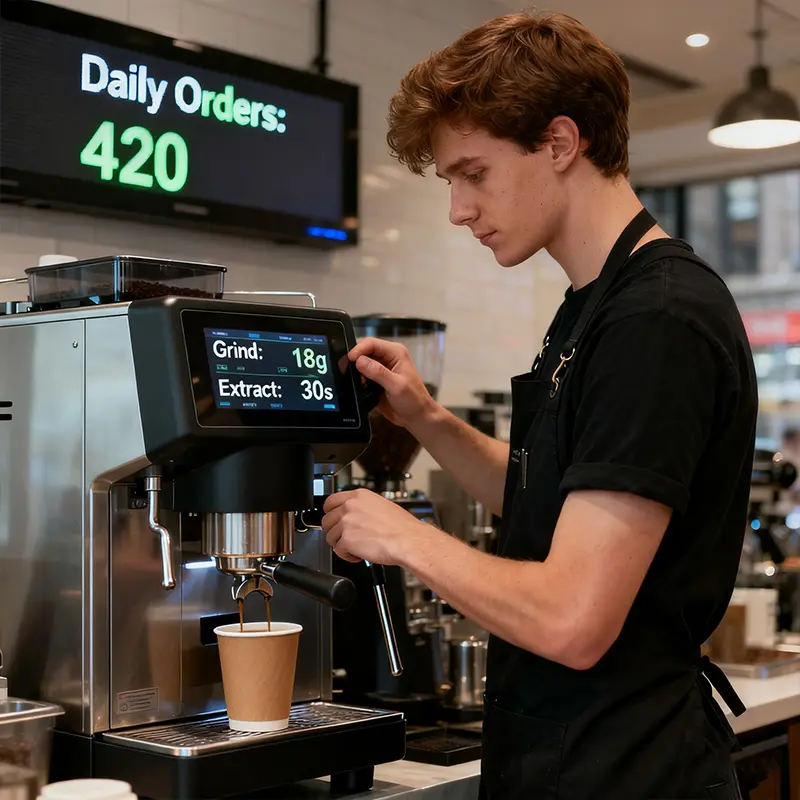
For stores with over 300 daily orders, automation is a must. 1. Match Equipment to Order Volume: Equip fully automated systems with extraction times under 30 seconds per cup to integrate grinding, tamping, and extraction. Use weight-based grinders to ensure the coffee powder quantity per cup is accurate to 0.1 grams, avoiding flavor inconsistencies caused by manual operations. 2. Introduce Collaborative Robots: Deploy robots for repetitive tasks such as food delivery, cleaning, and ingredient restocking, which can reduce labor needs by 30% and work continuously for 8 hours. 3. Optimize Barista Training: Focus on cultivating baristas' knowledge of coffee beans, customer communication skills, and personalized brewing capabilities, rather than just button operation. Case in point: A Manhattan coffee shop increased its daily orders from 320 to 420 after implementing upgrades, and complaints about "inconsistent flavor" dropped by 0%.
Adopt Energy-Saving Equipment for Green Operations
Sustainable operations are themselves a marketing highlight. 1. Equipment Iteration: Replace old equipment with coffee machines and refrigerators featuring automatic shutdown and energy-saving modes, which can reduce energy consumption by 25%. 2. Standardize Usage: Establish equipment records to clarify startup and shutdown times, avoiding waste caused by leaving equipment on inadvertently. 3. Proactively Promote: Display environmental data such as "40% of electricity comes from solar energy" in stores and on social media, and launch a "$1 off for bringing your own cup" campaign. The practice of Starbucks' green stores proves that these measures can reduce monthly energy costs by 18% while attracting a large number of environmental enthusiasts as repeat customers.
3. Build Community & Unique Experience Spaces
Today, coffee shops are no longer just places to buy drinks, but also carriers of social interaction and lifestyles. By building a sense of community and unique experiences, you can enhance customer loyalty, convert one-time consumers into loyal fans, and form a stable source of revenue.
Host Themed Events to Enhance Customer Engagement
A multi-tiered event strategy is key to improving retention rates. 1. Regular Basic Events: Hold free latte art workshops on the first weekend and coffee bean tasting sessions on the third weekend of each month, with on-site guidance from baristas. 2. Collaborative Traffic-Driving Events: Partner with coffee KOLs to launch "Home Barista Training Courses," charging a low registration fee that can be used as store credit to ensure participation. 3. Holiday & Hot Topic Events: Launch "spooky latte" making activities for Halloween, set up a viewing area during the World Cup, and offer "buy one get one free for the winning team's drinks." Combining these with a points system (50 points per event participation, 200 points for a free drink) yields even better results. Seesaw Coffee uses this strategy, achieving a 45% retention rate among young customers, far exceeding the industry average of 28%.
Try Innovative Formats: Pop-Ups & Co-Working Spaces
Break away from the static store model to drive unexpected foot traffic. 1. Pop-Up Collaborations: Partner with art galleries, bookstores, and music festivals to set up temporary stalls on weekends or holidays. Copenhagen's renowned restaurant Noma, now transformed into a food lab, regularly holds coffee pop-up events that attract long queues. 2. Co-Working Services: Target professionals by setting up private work areas in the store with high-speed WiFi, charging facilities, and printing services. Launch a $99 monthly package (including 15 cups of coffee + unlimited access to the work area). This model not only boosts off-peak revenue but also turns the store into professionals' "second office," enhancing user dependence.
4. Innovate for Gen Z: Aesthetics & Flavors
Gen Z is the largest coffee-consuming group today, and their consumption decisions are driven by both social shareability and a desire for novelty. Beverages with appealing aesthetics and unique flavors are not only daily choices but also "check-in staples" on social media.
Design Instagram-Worthy Beverages
Focus on three key aspects: Color (contrasting combinations such as matcha green + milk white layers, pomelo cold brew + butterfly pea blue), Shape (creative decorations like 3D-printed sugar flowers, edible gold leaf, and fruit slice garnishes), and Packaging (custom-patterned cups + reusable logo stickers that allow customers to DIY). Set up a "check-in area" in the store with green plants, neon lights, and vintage furniture, and launch a "Post to Instagram for a Free Cookie" campaign. A Seoul coffee shop's gradient orange yuzu cold brew became a viral hit due to its attractive appearance, driving a 70% month-on-month revenue increase—excellent visual presentation is highly appealing to Gen Z.
Innovate with Flavor Blends to Enrich Taste Layers
"Cross-category flavor fusion" has become a prevailing trend in the coffee industry. Combining coffee with local ingredients and fruits can create unique tastes. There are two core approaches: 1. Regional Flavor Integration: Add rice wine/osmanthus for Chinese communities and coconut/mango for Southeast Asian communities to create a sense of "familiarity + freshness." 2. Cross-Category Blending: Experiment with combining coffee with grains (barley, quinoa), dairy products (goat milk, cheese), and even launch "coffee + alcohol" beverages (such as espresso mixed with red wine) for evening consumption. Control the pace of innovation: Launch 1-2 limited-edition drinks monthly and convert bestsellers into regular menu items based on sales. Lucky Coffee maintains its popularity by launching 14 new SKUs annually, and its unique blends are the core reason for repeat customer visits. It's important to balance the original flavor of coffee with the taste of ingredients, rather than overshadowing the coffee's aroma.
5. Optimize Operational Models to Boost Profit Margins
Attracting customers to the store is just the first step; backend operational efficiency is the key to boosting profits. Many coffee shops neglect supply chain management and takeout channel development, resulting in high costs and a single revenue stream. Optimizing these two areas can form a complete profit loop of "attract - retain - increase revenue."
Build a Cost-Effective Supply Chain While Ensuring Quality
Core Goal: Reduce costs without compromising quality. 1. Direct Sourcing from Origin: Cooperate directly with producing regions such as Yunnan (China), Colombia, and Ethiopia, skipping middlemen to reduce coffee bean procurement costs by 20%-30%. Sign long-term agreements with local suppliers for functional ingredients and fruits to ensure stable supply and favorable prices. 2. Dynamic Inventory Management: Use POS system data to analyze sales, accurately predict demand, and adjust raw material inventory to reduce overstock and waste. A Shanghai coffee shop reduced its raw material waste rate from 12% to 5% using this method, saving $800 in monthly costs. 3. Coffee Bean Blending: Mix premium beans with regular beans to maintain taste while reducing costs. Yinliu Coffee achieved a balance between quality and cost through this method, and optimizing raw material costs directly increased its profit margin by 8%.
Deepen Takeout Channels to Increase Order Volume
Takeout accounts for 40% of coffee shop revenue today, so it cannot be ignored. 1. Packaging Upgrade: Use leak-proof, insulated (or cold-preserving) special boxes to avoid issues such as milk foam collapse and beverage leakage. For example, Starbucks equips takeout lattes with three-layer insulated boxes that can maintain the drink's temperature for 2 hours. 2. Targeted Marketing: Set up exclusive coupons on major takeout platforms (such as "$3 off for orders over $15"), participate in platform activities like "limited-time flash sales" and "group purchases" to increase exposure, and establish a "takeout member points" system to encourage repeat orders. 3. Optimize Takeout Order Scheduling: Predict peak hours (such as 8:00 AM - 10:00 AM, 12:00 PM - 2:00 PM) based on historical data and assign dedicated staff to handle takeout packaging and handover to avoid order delays. Through the above measures, Yinliu Coffee achieves over 500 daily takeout orders, accounting for 55% of the store's total orders and becoming a core revenue source.
Pro Tips & Profit-Killing Pitfalls
Master the following practical tips and avoid common pitfalls to save time and improve the success rate of your operation.
Practical Operational Pro Tips
1. AI Dynamic Pricing: Install an AI pricing system to adjust beverage prices in real-time based on weather, holidays, and order volume. For example, increase prices by 10% on rainy days (peak takeout demand) and decrease by 15% during off-peak hours to stimulate consumption, which can boost the store's daily revenue by 12%. 2. Environmental Value-Added Strategy: In addition to "bring your own cup discounts," cooperate with local environmental organizations to launch a "5 used coffee cups for 1 free drink" campaign, which not only reduces environmental pollution but also enhances brand reputation. 3. Limited-Edition IP Collaborations: Partner with local cultural IPs, cartoon characters, or fashion brands to launch limited-edition cups, co-branded beverages, and peripheral products. A London coffee shop collaborated with a local comic IP to launch a co-branded latte, selling 10,000 cups in the first week.
Common Profit-Killing Pitfalls
1. Blindly Opening Large Stores: Many operators pursue a "grand" image and rent large spaces in prime locations, resulting in rent accounting for over 30% of revenue. The correct approach is to choose the store size based on the target customer group—for example, open a 30-50 square meter takeout-focused small store in office areas and an 80-100 square meter medium-sized store with a dining area in business districts. 2. Neglecting Taste Consistency in Innovation: Some coffee shops overly pursue "novelty," launching beverages with weird flavors, or causing significant taste differences in the same beverage due to inconsistent production standards, failing to build a stable customer base. 3. Ignoring Digital Operations: Not promoting on social media, not establishing a membership system, and not analyzing sales data lead to vague customer profiles and poor marketing results. Avoiding these pitfalls is the basic prerequisite for ensuring profitability.
Profiting from a coffee shop today requires breaking traditional mindsets: developing functional beverages, advancing automation upgrades, building community spaces, attracting Gen Z customers, and optimizing operational efficiency. These five strategies can accurately address pain points such as homogeneous menus, high costs, and low retention, achieving stable profits. In the cost-reduction and efficiency-enhancement chain, high-quality and cost-effective supplies are a key link that is easily overlooked—we can provide you with customized packaging solutions with food-grade safety guarantees, supporting your profitability from aesthetic packaging to cost control. Contact us now to get exclusive custom coffee cup quotes and samples, turning every cup of coffee into a brand business card and laying a solid foundation for profitability in the details.